Key Performance Indicators (KPIs) for Goalkeepers in Football
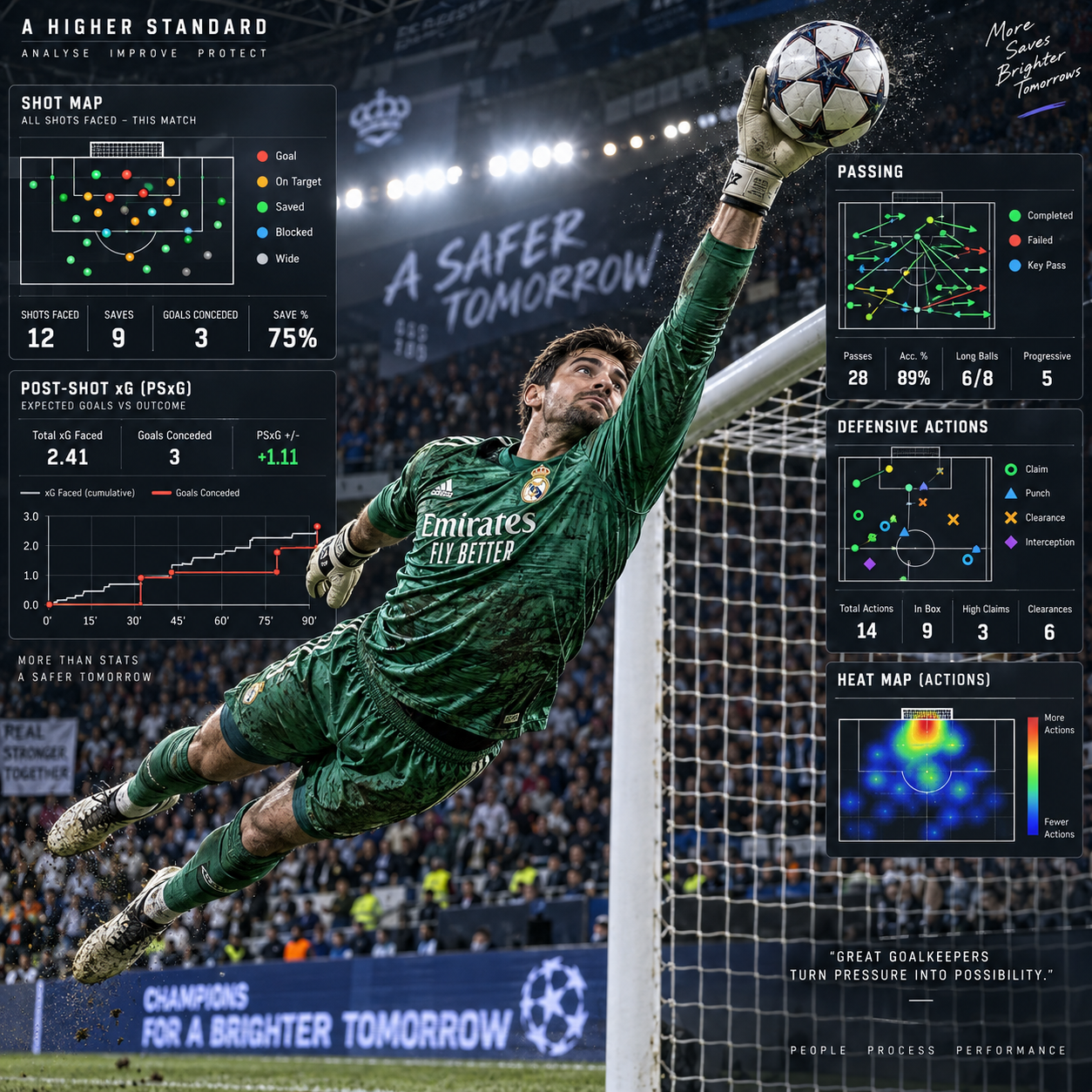
Goalkeeper performance is difficult to judge from the scoreboard alone. Goals conceded and clean sheets describe outcomes, but they do not fully reveal the quality of shots faced, the goalkeeper’s positioning, or their contribution during possession. A strong KPI model combines shot-stopping, handling, defensive control, distribution, and decision-making.
Why Goalkeeper KPIs Matter
Goalkeeper KPIs create a structured way to measure performance beyond goals conceded and clean sheets. They help analysts separate individual actions from the quality of the team defending in front of the goalkeeper.
A goalkeeper behind a dominant defence may face few shots, while another may regularly confront high-quality chances after defensive breakdowns. Comparing only goals conceded can therefore reward team structure rather than goalkeeper ability. KPIs provide a more detailed view for coaches, scouts, recruiters, and performance analysts.
The most useful framework separates data into four questions:
- Did the goalkeeper stop difficult shots?
- Did they control crosses and second balls?
- Did they protect space behind the defensive line?
- Did their distribution support the team’s tactical plan?
Each KPI has a specific use case and a limitation. A metric should be interpreted alongside role, opposition, playing time, defensive tactics, and the quality of opportunities faced.
Shot-Stopping KPIs
Shot-stopping KPIs measure how effectively a goalkeeper deals with shots after accounting for volume and chance quality. Save percentage is useful as a basic indicator, while PSxG, xGOT, and goals prevented provide more detailed context.
Save percentage and goals conceded
Save percentage is generally calculated as saves divided by shots on target faced. It offers a simple view of how often the goalkeeper prevents an on-target attempt from scoring. However, it treats many shots as broadly comparable, even though a low shot from distance is very different from a close-range finish.
Goals conceded is an important outcome metric, particularly for match results and defensive review. Its weakness is that it depends heavily on the team’s defensive quality, shot volume, and opponent strength. A goalkeeper may concede twice from excellent finishes while another concedes once after facing only weak attempts.
PSxG, xGOT, and goals prevented
Post-shot expected goals, or PSxG, estimates the probability that a shot on target becomes a goal after the shot has been struck. It considers factors such as placement and trajectory, making it more relevant to goalkeeper evaluation than a pre-shot expected-goals value alone.
Expected goals on target, or xGOT, is used by some providers to describe the expected goal value of shots that actually reach the target. Definitions can vary between data companies, so analysts must confirm the model specification before comparing competitions or platforms.
Goals prevented is commonly estimated by subtracting actual goals conceded from the PSxG or xGOT value of shots faced. A positive result suggests the goalkeeper conceded fewer goals than the model expected; a negative result suggests they conceded more. The exact formula depends on the provider, especially regarding penalties, own goals, rebounds, and shot handling.
Use these metrics together. A goalkeeper with an ordinary save percentage but strongly positive goals prevented may face unusually difficult shots. Conversely, a high save percentage built mainly on low-value attempts may overstate performance.
Handling, Crosses, and Defensive Control
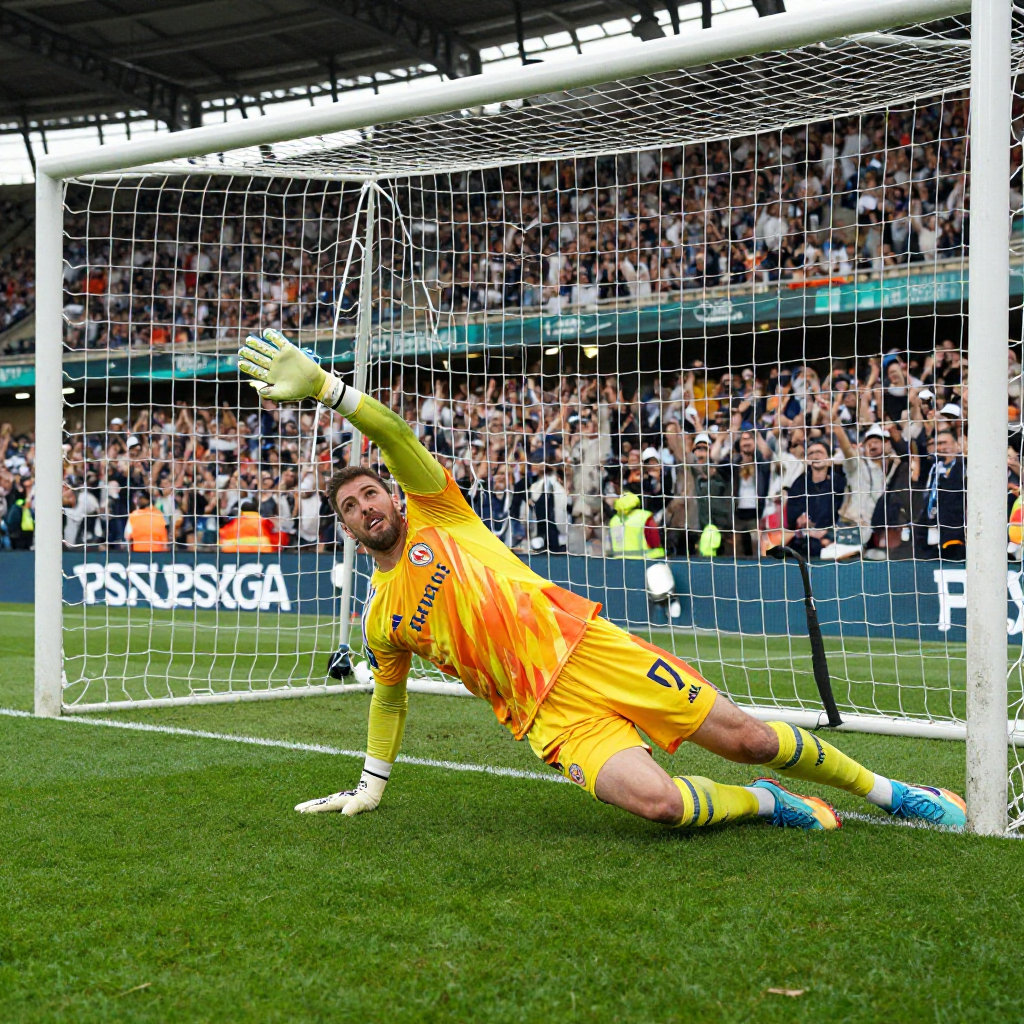
Handling and cross-stopping KPIs measure how well a goalkeeper reduces danger before an aerial delivery becomes a shot. Cross-stopping percentage, claims, punches, and handling errors should be reviewed as a connected group rather than as isolated totals.
Cross-stopping percentage typically measures the share of relevant crosses or aerial balls that the goalkeeper claims or successfully deals with. It can indicate command of the six-yard box, timing, courage, and judgment. Yet the metric is highly sensitive to cross location, delivery speed, crowding, weather, and the goalkeeper’s tactical instructions.
Claims and punches reveal different choices. A clean claim can end an attack and retain possession, while a punch may be the safest option under pressure. Counting punches as failures would therefore misread the situation. Video review should establish whether the decision reduced danger and matched the match context.
Analysts should also track:
- Handling errors that lead directly to shots or goals.
- Claims under pressure from opponents.
- Successful collection of corners and free kicks.
- Second-phase outcomes after punches or incomplete claims.
- Starting position and movement before the cross arrives.
A goalkeeper who claims fewer crosses may still perform well if the defensive line prevents dangerous deliveries or if the tactical plan prioritizes staying on the goal line. Cross-stopping data becomes more meaningful when normalized by the number and type of crosses faced.
Sweeper-Keeper and Defensive Contribution
Sweeper-keeper KPIs measure how effectively a goalkeeper protects space outside the penalty area and supports a high defensive line. Defensive actions outside the penalty area, one-on-one interventions, recoveries, and clearance decisions show how the goalkeeper contributes before a shot occurs.
Defensive actions outside the penalty area may include clearances, interceptions, recoveries, and challenges beyond the box. These actions are especially relevant for teams that defend with a high line and leave space behind central defenders. A goalkeeper who arrives early can prevent a through-ball from becoming a one-on-one.
Sweeper-keeper actions should be judged by timing and outcome, not volume alone. A high number may indicate proactive coverage, but it can also reflect repeated exposure caused by a vulnerable defensive structure. Useful supporting measures include:
- Distance from goal when the action occurs.
- Success rate of interventions.
- One-on-one outcomes after defensive-line breaches.
- Errors leading to shots or possession losses.
- Recovery time and ability to reset the defensive shape.
Role matters. A goalkeeper in a deep block may have little opportunity for sweeper-keeper actions, while a possession-oriented team may demand constant coverage behind advancing defenders. Comparing raw totals across these systems can produce misleading rankings.
Distribution and Build-Up KPIs
Distribution KPIs assess whether a goalkeeper starts attacks accurately, safely, and in a way that supports the team’s possession model. Passing accuracy matters, but progressive passing, completion under pressure, and decision quality explain more about practical value.
Passing accuracy measures completed passes as a share of attempted passes. It is a useful starting point, yet a goalkeeper can achieve a high rate by choosing only short, low-risk options. That may be correct for one tactical system and inadequate for another.
Progressive passing captures passes that move the ball meaningfully toward the opponent’s goal or advance the team through lines. Analysts should distinguish between safe progression into an available full-back and ambitious passes that bypass pressure. Long-pass success, target selection, and the next action after receipt all help explain the value of distribution.
Important questions include:
- Does the goalkeeper complete passes when pressed by one or more opponents?
- Can they switch play accurately to the weak side?
- Do long passes find a teammate or merely surrender possession?
- Does their positioning create a passing lane for central defenders?
- Do distribution decisions match the score, time, and opposition press?
A low completion rate is not automatically poor if the goalkeeper attempts difficult progressive passes required by the game model. Conversely, high passing accuracy can conceal conservative choices that slow build-up.
How to Interpret Goalkeeper Data in Context
Goalkeeper KPIs should be interpreted within team tactics, defensive quality, opposition strength, shot profile, possession, sample size, and playing time. Context turns a statistical description into a meaningful performance evaluation.
Start with the defence. Centre-back quality, pressing intensity, block height, and the frequency of defensive errors all affect the goalkeeper’s workload. Then examine the shot profile: number of shots on target, location, angle, shot type, rebounds, and one-on-one situations.
Team possession also changes distribution expectations. A goalkeeper for a team that dominates the ball may face fewer shots but receive more passes under pressure. A goalkeeper on a counterattacking side may attempt more long passes and face more transition attacks.
Opponent quality matters as well. Performance against elite finishers should not be treated identically to performance against low-volume attacks. Use match-level and seasonal data where possible, and avoid strong conclusions from a short run of games. Goalkeeper events are relatively infrequent, so small samples can be distorted by one error or an unusually difficult fixture.
Useful comparison controls include:
- Per 90 minutes for actions and involvement.
- Per shot on target for shot-stopping outcomes.
- Possession-adjusted or opportunity-adjusted rates where appropriate.
- Separate home, away, competition, and opponent-strength samples.
- Video validation for unusual or high-impact events.
Building a Balanced Goalkeeper Evaluation Model
A balanced goalkeeper evaluation model combines shot-stopping, defensive control, distribution, reliability, and role-specific actions. The model should reflect the team’s playing style instead of assigning every goalkeeper the same statistical priorities.
A practical five-part framework is:
- Shot-stopping: Review PSxG or xGOT against goals conceded, goals prevented, save percentage, and shot difficulty.
- Handling: Assess cross-stopping percentage, claims, punches, aerial control, and handling errors.
- Defensive coverage: Measure actions outside the penalty area, sweeper-keeper interventions, one-on-one decisions, and defensive-line support.
- Distribution: Combine passing accuracy, progressive passing, long-pass success, pressure resistance, and tactical decision-making.
- Reliability and fit: Review availability, repeatability, communication, role suitability, and performance against the team’s likely opponents.
Do not assign fixed weights without a tactical reason. A high-line possession team may prioritize sweeper-keeper actions and progressive passing, while a deep-block side may place greater emphasis on shot-stopping and cross control. The model should also preserve a qualitative layer: video evidence can explain whether a metric reflects skill, instruction, or circumstance.
Goalkeeper KPI FAQ
Which KPI is most important for evaluating a goalkeeper?
No single KPI is sufficient. PSxG or xGOT-based goals prevented is valuable for shot-stopping, but it should be combined with handling, defensive actions, distribution, and role context.
How is goals prevented calculated?
It is commonly estimated by subtracting actual goals conceded from the expected goals value of shots on target, often using PSxG or xGOT. Providers may use different definitions, so the formula must be checked before comparison.
Are clean sheets a reliable goalkeeper KPI?
Clean sheets are useful team outcomes, but they are not a complete goalkeeper measure. Defensive organization, opponent finishing, possession, and shot volume strongly influence them.
What is the difference between save percentage and PSxG?
Save percentage records the share of shots on target saved. PSxG estimates the difficulty of those shots after they are struck, making it more informative when shot quality varies.
How should goalkeeper KPIs be compared across different teams?
Compare similar roles and control for defensive system, shot profile, opposition, possession, playing time, and sample size. Combine adjusted data with match video before making recruitment or coaching decisions.