How Machine Learning Is Used to Predict Match Outcomes Across Multiple Sports
Why Match Outcome Prediction Matters in Modern Sports Analytics
Match outcome prediction has moved well beyond the realm of gut instinct. Today, performance departments at professional clubs, broadcast analytics teams, and sports data companies all rely on structured predictive systems to gain an edge — whether that means optimizing squad selection, informing tactical preparation, or enriching live coverage with real-time probability data.
The practical applications span a wide range. A Premier League club might use predictive models to assess the likelihood of a top-four finish based on fixture difficulty and squad depth. A broadcaster might display win probability shifts after a red card. A sports scientist might query whether travel schedules affect performance outcomes in international basketball. These are not abstract questions — they carry real operational weight.
What makes machine learning particularly well-suited here is its capacity to process large volumes of structured data and detect patterns that resist straightforward statistical analysis. Traditional regression models can identify linear relationships. ML models can find the complex, non-linear interactions between variables that actually drive results on the pitch, court, or field.
The Core Machine Learning Approaches Used in Sports Prediction
Three model families dominate sports outcome prediction: random forests, gradient boosting, and neural networks. Each brings different strengths depending on data volume, interpretability requirements, and the nature of the sport.
Random forests work by building many decision trees on random subsets of the training data, then aggregating their outputs. They handle mixed data types well — numerical form metrics alongside categorical variables like venue type — and are relatively resistant to overfitting. For sports with moderate data volumes and a need for interpretable outputs, random forests remain a practical default.
Gradient boosting methods, including XGBoost and LightGBM, build trees sequentially, with each tree correcting the errors of the previous one. In practice, gradient boosting frequently outperforms random forests on tabular sports data because it learns more efficiently from the signal embedded in historical match records. Many competitive sports analytics pipelines use gradient boosting as their primary model architecture.
Neural networks — particularly recurrent architectures like LSTMs — become relevant when temporal sequences matter. Predicting how a team's form evolves over a season, or how fatigue accumulates across a dense fixture schedule, benefits from models that treat data as a time series rather than a static snapshot. The trade-off is that neural networks require substantially more data and are harder to interpret, which can be a problem in sports contexts where explainability matters to coaching staff.
What Data Feeds the Models — Feature Engineering Across Sports
The quality of a prediction model depends less on the algorithm and more on the features fed into it. Feature engineering — the process of selecting, transforming, and constructing predictive variables from raw data — is where most of the real work happens in sports ML.
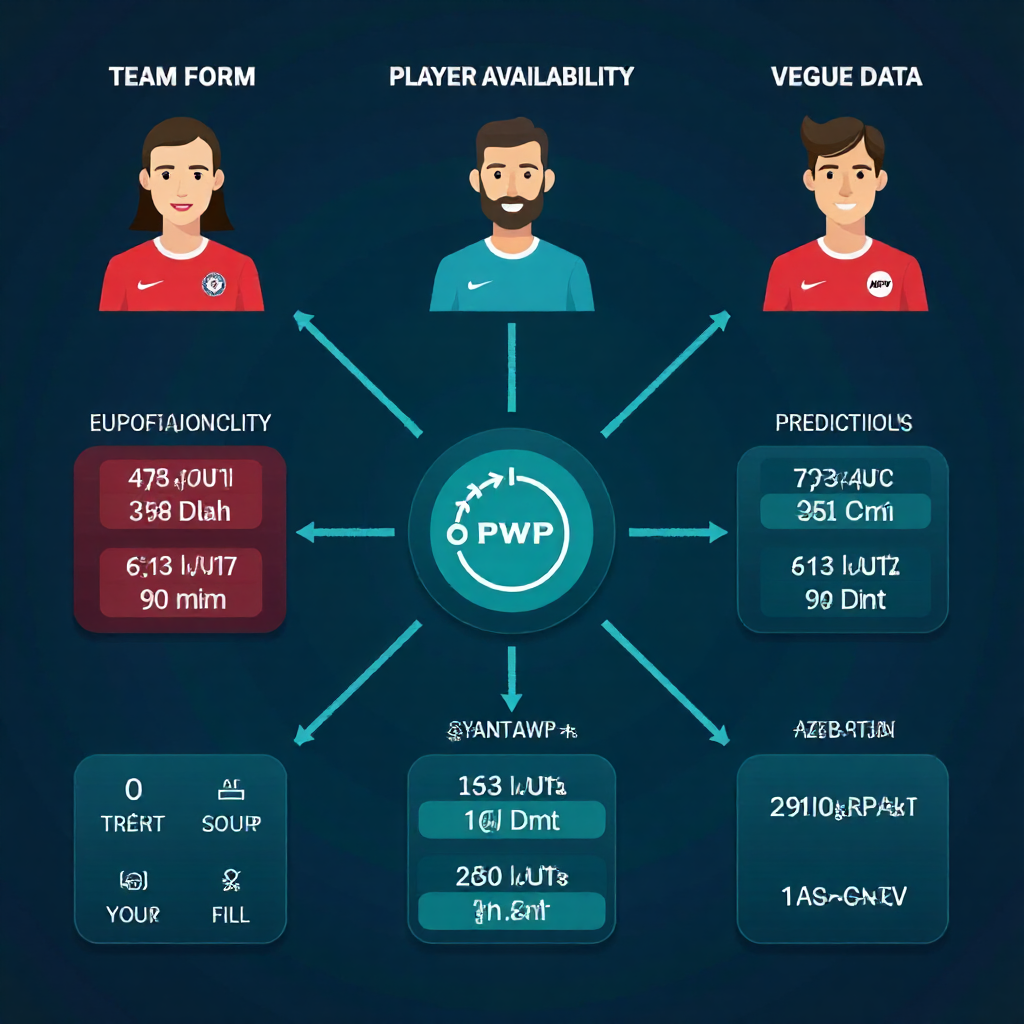
Across sports, a core set of predictive variables tends to appear: recent team form (typically the last five to ten matches), head-to-head records between opponents, home advantage metrics, and player availability. But the way these variables behave differs significantly between disciplines.
- Home advantage in football is well-documented and relatively stable — home teams win roughly 45% of matches in most top leagues. In basketball, the travel schedule and back-to-back game fatigue often matter more than the venue itself.
- Player availability carries different weight depending on squad depth. Losing a key midfielder in football may reduce win probability by a measurable margin. In tennis, player availability is binary — one injury ends the match.
- Weather and surface conditions are negligible in indoor sports but can be significant features in cricket or rugby, where pitch and weather data deserve explicit model inputs.
Building good features requires domain knowledge. An analyst who understands that a football team's defensive record changes after a managerial switch will engineer that transition as a feature. Someone without that context will miss it entirely. This is why multi-sport analytics teams typically include sport-specific subject matter experts alongside data scientists.
How Football Analytics Shaped Multi-Sport ML Prediction
Football's data ecosystem is the most mature in team sports, and its methodological development has directly influenced how analysts approach prediction in other disciplines. The sport's global scale — hundreds of leagues, decades of digitized match data, and commercial investment in tracking technology — created the conditions for ML experimentation earlier and at greater depth than most other sports.
Expected goals (xG), player tracking data, and event-level match logs became standard in elite football before comparable datasets existed in rugby union or handball. When analysts moved to those sports, they borrowed the football playbook: build a historical dataset, engineer form-based features, train a classification model, evaluate on held-out seasons. The approach transferred even when the sport did not.
Football also established the baseline for thinking about model accuracy expectations in sport. Even the best football prediction models struggle to exceed 55–60% accuracy on three-outcome predictions (win/draw/loss), largely because draws introduce a third class that is genuinely difficult to predict. This calibrated realism — understanding that sport contains irreducible uncertainty — is a lesson that carries across every discipline.
Adapting Models for Multi-Sport Contexts — Key Differences and Challenges
A model trained on football data cannot be dropped into a rugby or basketball prediction task without significant reworking. The differences go deeper than surface-level sport mechanics — they affect data structure, feature relevance, and outcome distributions in ways that require deliberate adaptation.
Consider scoring dynamics. Football matches are low-scoring, with results often decided by single goals. Basketball games involve hundreds of possession events and scores that can swing dramatically in the final minutes. A model architecture optimized for binary-adjacent football outcomes (where a single event can flip the result) will behave differently when applied to a sport where the margin of victory is routinely 15–20 points.
Data volume is another structural challenge. The English Premier League produces 380 matches per season. A national rugby union league might produce 90. Training a reliable ML model on 90 matches per season — especially one that accounts for squad rotation and tactical variation — is genuinely difficult. Analysts often compensate by pooling data across multiple seasons or leagues, which introduces its own risks around distribution shift (the game changes over time).
Cross-sport transferability is an active research area, but the honest assessment is that it remains limited. Features that are predictive in one sport often have no analogue in another. The concept of home advantage exists across sports, but its magnitude and mechanism differ enough that a shared feature encoding would be misleading rather than helpful.
Measuring Model Performance — What Accuracy Really Means in Sports ML
Accuracy alone is a poor metric for evaluating sports prediction models. A model that always predicts the home team to win in football might achieve 45% accuracy without learning anything meaningful — it has simply exploited the base rate. Better evaluation frameworks use metrics that account for the full probability distribution a model produces.
Log loss (also called cross-entropy loss) penalizes confident wrong predictions more heavily than uncertain ones, which makes it a more honest measure of model calibration. A model that assigns 90% probability to an outcome that doesn't happen is penalized heavily — as it should be. Precision-recall analysis is useful when the cost of false positives and false negatives differs (for example, predicting upsets versus predicting expected results).
Realistic expectations matter here. Sports are inherently unpredictable. Injuries, referee decisions, weather shifts, and the psychological variability of human performance all introduce noise that no model can fully capture. A well-calibrated model that achieves 52–58% accuracy on football outcomes while producing reliable probability estimates is genuinely useful — not because it predicts every match correctly, but because it quantifies uncertainty in a structured, actionable way.
The Future of ML-Driven Match Prediction in Multi-Sport Environments
The next phase of sports ML prediction is being shaped by three developments: real-time data integration, ensemble architectures, and early progress toward sport-agnostic prediction frameworks.
Real-time data feeds — player tracking, physiological monitoring, in-game event streams — allow models to update win probability continuously during a match rather than only pre-game. This shifts the value proposition from pre-match prediction toward live analytics, which has clear applications in broadcast, coaching, and performance monitoring.
Ensemble models that combine the outputs of multiple base models (a gradient boosting model for form-based features, a neural network for sequential data, a Bayesian model for low-data sports) are showing promise in research settings. No single architecture dominates across all sports and data conditions, so combining them intelligently often outperforms any individual approach.
The idea of a truly sport-agnostic prediction framework — one that can be trained on data from any sport with minimal reconfiguration — remains largely aspirational. But progress in transfer learning and meta-learning suggests that shared representations of competitive dynamics (momentum, fatigue, home context) may eventually support more portable model architectures. For now, the practical standard remains sport-specific models built on sport-specific features, with football analytics providing the most developed methodological template.
Frequently Asked Questions
What is the most accurate machine learning model for predicting football results?
Gradient boosting methods — particularly XGBoost and LightGBM — consistently perform well on football prediction tasks using tabular match data. Ensemble approaches that combine gradient boosting with neural networks tend to outperform single-model systems, though the improvement is often marginal. No model reliably exceeds 60% accuracy on three-outcome football predictions.
Can the same ML model be used across different sports?
Not without significant adaptation. Scoring dynamics, data volumes, feature relevance, and outcome distributions differ enough between sports that direct model transfer produces poor results. Analysts typically build sport-specific models and share methodological approaches rather than model architectures.
What data is needed to build a match outcome prediction model?
At minimum: historical match results, team form metrics, head-to-head records, and player availability data. More sophisticated models add venue data, travel schedules, weather conditions, and in-game event data. Data quality and consistency matter more than volume — a clean dataset of 500 matches outperforms a noisy dataset of 5,000.
How reliable are machine learning predictions compared to traditional sports statistics?
ML models generally outperform simple statistical methods on complex, multi-variable prediction tasks because they capture non-linear interactions between features. However, the reliability ceiling is set by sport's inherent unpredictability, not by model sophistication. Both approaches should be treated as probability estimators, not outcome guarantors.
What are the biggest limitations of ML in sports outcome prediction?
The three most significant limitations are data scarcity in lower-profile sports and leagues, the irreducible randomness of competitive sport, and the difficulty of encoding qualitative factors — team morale, managerial tactics, individual motivation — as structured model inputs. These constraints apply regardless of which algorithm is used.